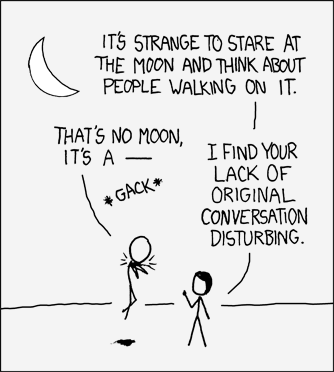
I have a lot of sympathy for the character Abed on the show "Community." In the world of the show, Abed presumably has Asberger's syndrom or something. He relates to the world predominantly through comparing it to TV, movies, and videogames. If he ever interacts like a normal human being, usually it is because he is impersonating a character from a TV show or movie. As for me, I don't generally adopt a persona to fit in, but I do find myself constantly comparing situations in life to fictional constructs, whether TV, movies, videogames, books, or song lyrics. I've been this way for a long time. When I wanted my dad to purchase a new computer for the family, in my mind I framed it as though my brother and I (and possibly some friends) were forming a party to go on a quest, ala RPGs or Dungeons & Dragons. When Anodos wakes the maiden from the marble in "Phantastes" and then she ends up with the knight instead, I applied it to a girl I liked at the time I read the book, a girl who was interested in someone else. And of course, as anyone who knows me knows, I love coming up with a quote from something that matches the current situation. And it is easy to do. As the Teacher said, "There is nothing new under the sun." Everything is like something that came before. I think my brain loves forming connections between things. Perhaps that is the way Abed's mind works, too. And Madeleine L'Enge had this to say of George MacDonald, one of my heroes: "[he] is the grandfather of us all -- all who struggle to come to terms with truth through fantasy. So I think for me, seeing connections to fiction in my real life helps me process what I'm going through.
That said, there is a very real danger in overdoing this. Not only might I annoy my friends with my incessant quoting, more importantly I might force a construct or a presupposition onto reality that simply isn't there. For example, just because a character in a movie had headaches and it turned out to be a tumor doesn't mean I have one. Or take season 1 of Friends. Ross pines away for Rachel for a year and then gets her attention mostly by accident (through Chander's verbal slipup). But just because it happened that way on a show I like doesn't make it a smart approach to romance. In fact, I readily offer several of my teen years as a counter-argument.
So turning to spiritual matters, when I read about the life of one of my heroes of faith, in the Bible or otherwise, it is tempting to want to follow suit as explicitly as possible, and thereby hope to guarantee the same result. This sort of thinking goes, "Well, the early apostles did this, and the church grew rapidly, so if I do that and pray about it, God will reward me the same way." I see a lot of this in other people too. There is a lot to learn from the early church, but that doesn't mean we should automatically emulate everything, nor should we always expect the same results. (Can you tell I'm sick of Acts 2:42-47?) Don't get me wrong; despite my strong dislike of the movie, I agree with the concept of praying and then waiting for (expecting) rain, as expressed in "Facing the Giants." It's just that the rain might arrive in a different fashion than we are expecting. And when we got locked into a narrative, it is easy to miss blessings when they come in unexpected ways. By all means, I think it is good to see connections, maybe even to parallel your challenges to David and Goliath. Just don't extrapolate the ending. God will triumph, of that you can be sure - but don't bind him by what has happened in the past. You don't know: perhaps there is something new under the sun after all.

No comments:
Post a Comment